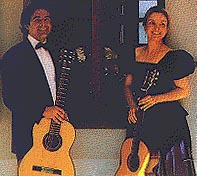
| SUSANNE MEBES & JOAQUIM
FREIRE guitar duo
|
Cannes
Classical Award Winners!
CD: LC44401
CD: LC4125-401

Susanne Mebes
Joaquim Freire
Additionally to their individual careers as soloists, SUSANNE
MEBES and JOAQUIM FREIRE do also since several years very much
enjoy playing duo programmes together. Apart from their solo CD
recordings for Léman Classics, their first recording as a duo,
'Fugas y Fandangos', has won one of the prestigious 'Cannes Classical
Awards' that are attributed to the most outstanding releases worldwide.
|
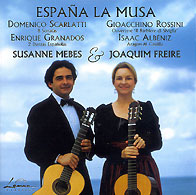
NEW RELEASE
!
Susanne Mebes & Joaquim Freire
play Scarlatti, Rossini,
Granados & Albéniz
CLASSICAL
GUITAR (UK)
« A quality release from
a world-class alliance » |
Press Reviews for 'Fugas y Fandangos', Léman Classics
LC 44401:
FANFARE The Magazine for
Serious Record Collectors
Given the evidence of their past recordings, Mebes and Freire ought
to constitute a compelling guitar duo — or maybe not. With solo
artists of this caliber, ensemble playing often proves more than problematical.
In this case, the result is greater than the sum of its two estimable
parts. The mercurial Mebes and the more classically reserved Freire
play off against each other's strenghts, striking a balance that never
wavers and that provides the wherewithal for nine extremely convincing
and enjoyable performances.
The programming cachet of this release lies in its combination of fugue,
that most cerebral of musical forms, with the fandango — among
the most visceral of musical manifestations. The result is music of
the head and heart that is, like this duo, mutually reinforcing. After
a taut and spiky performance of Falla's "Premiere Danse Espagnole"
from La Vida Breve (transcribed by Pujol and arranged by Mebes
and Freire for two guitars) — a reading that throws the metrically
plodding gentility of Bream and Williams (RCA 09026-61450-2) into relief,
the duo shows the depth of its interpretive insight in the three preludes
and fugues culled from Castelnuovo-Tedesco's Les Guiatres bien tempérées,
op. 199. This is fine ensemble. The two voices are totally subsumed
into the music's constantly evolving textures and provide performances
that are at once fully calculated and spontaneous. In the E-Major Prelude
and Fugue, they outclass the Strano Duo on Walsingham WAL 8015-2. I
hope Mebes/Freire get around to recording the remaining twenty-one preludes
and fugues.Castelnuovo-Tedesco's challenging Sonata canonica is given
a reading that highlights its ubiquitous counterpoint and, in the end,
makes music of the whole enterprise anyway. The remaining Granados and
Falla pieces (transcribed by Pujol and arranged for two guitars by Mebes
and Freire) are given idiomatically and thoroughly delightful readings.
The sound is up to Léman Classics' high standards. This one
is, not surprisingly, a winner.
William Zagorski
L'EXPRESS
(Suisse): Pour l'amour du son
Concert pour le moins aristocratique que celui donné dimanche en la
Salle des Chevaliers du château de Neuchâtel par les guitaristes Susanne
Mebes et Joaquim Freire, tant par le prestige du lieu que par l'éblouissante
finesse de jeu des deux interprètes qui, devant un public choisi, égénèrent,
dans une grande unité de style, des pièces italiennes et espagnoles
du début du siècle. Mario Castelnuovo-Tedesco, bien connu des amaterus
de guitare, s'est voulu le Bach de cet instrument, ses "guitares bien
tempérées" alternent préludes et fugues dans une atmospère feutrée,
parfois un peu conventionnelle, mais dont les interpètes ont su constamment
relever l'intérêt par des trouvailles sonores d'une subtilité époustouflante.
Le danger d'un jeu si porté au culte des détails est souvent, dans un
concert de guitare, que l'en en vient à perdre l'architecture d'ensemble
et à se confiner dans une suite finalement monotone d'instantanés. Rien
de tel ici cependant: Susanne Mebes et Joaquim Freire, amoureux déclarés
du beau son, savent pourtant construire avec toute l'ampleur requise
des pièces d'envergure: la Sonatina canonica de Castelnuovo-Tedesco
en prenait une dimension qui ne la rendait jamais ennuyeuse. Des pièces
de Granados et Manuel de Falla complétaient ce programmme sans tomber
dans l'espagnolade facile: harmoniques, sons étouffés presque impalpables,
notes perlées et déliées avec dextérité, ce fut une véritable feria
et l'on apprécia particulièrement que le bis, "Cordoba" d'Albéniz, fût
une pièce lente et méditative où la virtuosité n'avait rien à faire.
Alain Corbellari
DER BUND (Schweiz, Bern)
: Kammermusik-Kleinod
Die junge Holländerin Susanne Mebes und der am Freiburger Konservatorium
wirkende Brasilianer Joaquim Freire stellten mit ihrem Konzert in der
Französischen Kirche einem gebannten Publikum das Programm ihrer demnächst
erscheinenden CD "Fugas y Fandangos" (Léman Classics) vor. Mit Ausnahme
von "El Fandango de Candil" (Enrique Granados) und Manuel de Fallas
"Danse de la Meunière" präsentierten die beiden Künstler ausschliesslich
Werke, die schon im Original für zwei klassische Gitarren gesetzt wurden,
und sie boten eine hervorragende Gelegenheit, dem kompositorischen Charme
des hierzulande doch weniger bekannten Zeitgenossen Mario Castelnuovo-Tedesco
zu begegnen. Aus dem 1962 entstandenen Werk " Les Guitares Bien Tempérées"
erklangen drei Präludien und Fugen. Obwohl konstruktiv an der barocken
Form der Fuge orientiert, erschienen letztere als zierliche und leitverständliche
Kompositionen mit mehrmals liedhaften, ja volksliederartigen Themen.
Die überlegene Leichtigkeit, mit welcher Susanne Mebes und Joaquim Freire
die Werke interpretierten, verstärkte den Eindruck, dass es sich beim
Komponisten viel mehr um einen verspäteten Romantiker denn um einen
(laut Lexikon) "gemässigten Modernen" handelt. Mit makellos sauberer
Intonation, warmem Klang und perfekter Technik ergänzten die beiden
Künstler ihre verschiedene musikalische Identität zu einem vollkommenen
Ganzen: Freire verfügte über einen etwas intensiveren Ton, er modellierte
sozusagen das Terrain, über welchem Susanne Mebes ihre melodischen Träume
schweben lassen konnte. So wurde das Spiel der beiden in feinsten Nuancen
spannungsvoll und lieferte einen eindrücklichen Beweis dafür, dass Ausdrucksstärke
keinesfalls von Lautstärke abhängig ist.
|